

Bitte klicken Sie auf die Flagge, um den Text auf Deutsch zu lesen.
The Surprising Renaissance of an Almost Forgotten Technology - Microfilm
Digitalisation has almost pushed microfilm out of public consciousness. Yet as cyberattacks, technological dependencies and the vulnerability of digital storage raise new questions, the archival world is rediscovering an old technology. Now Kodak, together with British specialist Genus, has returned to the international microfilm business.
Rochester/Nuneaton. It sounds like news from another era: Kodak returns to microfilm.
The American industrial giant, whose name is synonymous with the history of analogue photography, has already rebuilt its worldwide archival microfilm business in partnership with British specialist, Genus. What might initially appear to be a minor development in an obscure corner of the technology industry marks a remarkable industrial and technological turning point. Behind the exclusive distribution partnership between Eastman Kodak and Genus lies a question of surprising relevance:
How secure is the digital memory of our civilisation?
While billions are being invested worldwide in data centres, cloud infrastructure and artificial intelligence, a technology that many had already consigned to museums is attracting renewed attention.
Microfilm.
An analogue storage medium that requires no electricity, is independent of software, cannot be encrypted by a cyberattack and, under appropriate conditions, can preserve information for at least 500 years.
George Eastman’s Legacy
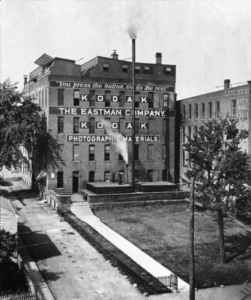
The story begins in Rochester, New York, where George Eastman laid the foundations of one of the most influential companies in photographic history during the late nineteenth century. Eastman was a pioneer of industrial photography. With the introduction of flexible roll film and the Kodak camera in 1888, he made photography accessible to millions of people. Less widely recognised is the role his industrial vision would play in the long-term preservation of information.
In 1928, Kodak’s subsidiary Recordak introduced a microfilming system originally developed for the space saving storage of banking documents. The concept was as simple as it was revolutionary: documents were photographically reduced and preserved on film.
From this innovation, an entire global industry emerged.
Banks, insurance companies, libraries, universities, newspaper publishers and government archives began preserving their documents on microfilm. Entire libraries and historical newspaper collections could be stored
in remarkably little space. For decades, microfilm was one of the most important technologies for the long-term preservation of information. Then came the digital age.
When Progress Displaced Its Own Past
Computers, scanners and electronic databases fundamentally transformed document management. Information could suddenly be located within seconds, copied effortlessly and transmitted across continents.
By comparison, microfilm appeared slow, cumbersome and hopelessly outdated. Manufacturers reduced their activities, production capacities disappeared and entire supply chains were abandoned. Yet alongside its undeniable advantages, digitalisation introduced a new form of dependency. Digital information requires functioning technical systems to remain accessible. Hard drives and other storage
media have limited lifespans. File formats change, software disappears and operating systems become obsolete.
Anyone wishing to preserve digital information for centuries must continuously monitor, protect, verify and repeatedly migrate it to new technological platforms. Additional threats have emerged that George Eastman could scarcely have imagined: cybercrime, ransomware, hacking and the deliberate manipulation of electronic records. The question is therefore no longer simply how quickly information can be accessed. Increasingly, it is also how long that information can reliably survive.
An Archive Beyond the Reach of Hackers
Here, microfilm reveals a characteristic that seems almost extraordinary in our interconnected world.
Microfilm cannot be hacked.
A cybercriminal cannot remotely encrypt a physical roll of film through the internet. A computer virus cannot erase photographically recorded documents. Malicious software cannot remotely alter information preserved on silver-halide film. Naturally, microfilm remains a physical medium. It can be damaged, stolen, substituted or deliberately falsified. But these risks are fundamentally different from those associated with digitally stored information. Once a photographic image has been properly developed, it cannot simply be overwritten by an electronic command. Its defining advantage is independence.
The film requires no server, no operating system, no internet connection and no regular software updates. The information physically exists. In the simplest circumstances, light and optical magnification are sufficient to make it readable again. At a time when businesses and governments spend enormous sums protecting digital infrastructure, this technological simplicity is acquiring renewed importance.
Microfilm’s greatest strength may lie precisely in the fact that it is not part of that infrastructure.
500 Years – A Challenge to the Digital Age
Even more remarkable is its potential lifespan. High-quality silver-halide microfilm on a polyester base, correctly processed and stored under appropriate archival conditions, can achieve a projected life expectancy of 500 years or more according to recognised archival preservation standards.
Half a millennium.
To put that into perspective, 500 years ago, in 1526, Europe was experiencing the Renaissance. Printing was
transforming the distribution of knowledge. Electricity, computers and digital storage were still centuries
away. Yet documents from that period can still be read today. The challenge facing our generation is to ensure that the information created in the twenty-first century will
remain equally accessible.
Nobody knows which operating systems will exist in the year 2526.
Nobody can guarantee that today’s commonly used digital file formats will remain directly readable.
A photographically recorded document, however, is not dependent on a particular generation of software.
The 500-year figure is not an unconditional guarantee. It depends upon suitable materials, correct chemical
processing and controlled storage conditions. Nevertheless, this exceptional physical stability continues to make microfilm one of the most remarkable established media for long-term archival preservation.
Why Kodak Is Returning Now
Against this background, the partnership between Kodak and Genus takes on particular significance. The industry is undergoing a period of profound change. With Japanese manufacturer Fujifilm withdrawing from silver microfilm production, a major long-established supplier is leaving the market. For archives, service providers and institutional users, this creates new concerns regarding supply security, product quality and long-term availability. It is precisely at this moment that Kodak is rebuilding an international market presence alongside Genus.
Genus is among the specialist companies that have remained committed to microfilm throughout decades of technological change. The British company possesses extensive market experience and established international distribution relationships. The partnership combines this specialist market knowledge with one of the most recognisable names in the history of photographic film technology. The economic significance should not be underestimated. Re-entering a specialised market involves considerably more than reviving a famous brand. It requires manufacturing expertise, quality assurance, investment, reliable supply chains and international distribution capabilities. A company such as Kodak is unlikely to contemplate such a move purely out of nostalgia. The proposed partnership therefore suggests that Kodak continues to recognise a meaningful commercial future for analogue archival preservation.
Whether that assessment proves correct will ultimately depend on product quality, supply reliability and international demand.
A Niche Industry with a Responsibility Spanning Centuries
Compared with the global digital technology industry, the microfilm market may appear relatively small. But its importance cannot be measured solely in revenue. National archives, scientific libraries, government institutions and other organisations preserve information whose value extends far beyond its immediate commercial usefulness. Historical records, newspaper collections, legal documents and scientific knowledge are not intended solely for today’s generation.
They may need to survive for centuries. This is why an idea that had almost disappeared from mainstream discussion is becoming relevant again: Not every piece of information needs to be preserved exclusively in digital form.
Digital systems provide speed, flexible processing and worldwide accessibility. Microfilm can provide an independent, physically stable preservation layer.
The two technologies need not compete.
They can complement each other.
The future of archival preservation may therefore lie in combining digital accessibility with analogue long term security.
The Renaissance of an Underestimated Technology
Almost 100 years after the introduction of the Recordak system, a remarkable historical circle is closing. George Eastman’s company helped pioneer industrial microfilming. Digitalisation subsequently made the technology appear to be a relic of a bygone era. Now, paradoxically, the continuing advance of digitalisation may be contributing to its rediscovery.
Not because computers have failed. But because society is increasingly recognising that preserving knowledge permanently presents fundamentally different challenges from making it instantly accessible. Against this background, the worldwide partnership between Kodak and Genus would represent more than
another distribution agreement. It could become a visible symbol of a changing understanding of information security. Whether this development ultimately produces a genuine renaissance of microfilm remains to be seen.
Nevertheless, the message behind Kodak’s decision is remarkable: Technological progress does not necessarily mean that the newest solution is also the most durable.
