OPUS knows your archive better than your longest-serving archivist
Your archive holds history that cannot be replaced. Opus is designed to help you discover more of what it contains, without compromising the originals, your ownership, your professional judgement or the trust placed in your care. Look up a person, place or date, and Opus brings together the records that mention them from across your digitised collection, work that could otherwise take your team hours. Built specifically for collections like yours. Your collection stays private and is never used to train anyone else’s systems.
From Genus, the digitisation specialists trusted by the Royal Navy, the Imperial War Museums, the British Library and the Wellcome Trust.
Why a searchable archive still hides answers
Once a collection is digitised and run through OCR (optical character recognition, software that turns scanned pages into searchable text), you can search it by keyword. A keyword search looks for the words you type, and archive records rarely use the words a researcher does.
- You search “bomb damage”. The report says “air raid damage”.
- You search a modern place name. The archive uses the name it had in 1942.
- You search a full name. The minutes use initials.
- You search a surname that OCR misread on a faded page, so that page never comes up.
The answer is in the collection. The problem is finding it. Reaching it takes search after search, or a question to the one colleague who knows where to look. Links between records are harder still to find. A person, a building and a date can sit in separate files, written by different people decades apart, with nothing to connect them but someone’s memory.
Opus brings those answers together in one place.
Ask Opus a question in plain English, the way you would ask a colleague who knows the collection. It finds material that matches what you mean, even when the archive uses different words.
How Opus works
- 1Opus is set up on your digitised collection and trained only on that data.
- 2It connects the facts, people, places and dates across the collection.
- 3Your team asks about a person, place, date or event, and Opus answers with the source behind it.
- 4Your team checks the source and decides what it means.
What Opus can find across your collection
The slowest enquiries are the ones where the answer is spread across many records. With Opus, work that might take a team weeks may be done by one person in a matter of hours.
People.
Where a person appears across letters, reports, minutes and registers.
Places.
What the collection holds about a building or site.
Dates.
What was recorded on a given day, or across a period.
Events and decisions.
The records around an event, or the minutes and letters behind a decision.
Connected records.
How people, places and events connect, even when their records sit in different parts of the collection.
An index.
If your collection has never been fully catalogued, Opus can create an index of your photographs, documents and metadata.
Every answer comes with its source
An archive can’t use an answer it can’t trace. A reply to a researcher or an exhibition label needs a reference behind it.
Opus has citation and traceability built in, so every answer shows the source material behind it and anyone can go back to the original to check it.
Opus finds the evidence, and your archivists decide what it means. A person should always review what Opus finds before anyone relies on it.
Your collection stays private
Opus is a closed-loop system, which means your data stays inside it. It was developed by a team led by a former NATO Chief Technical Officer. The answers below cover what your IT team will want to know.
Where is our collection hosted?
Opus can run in a private cloud or on your own servers. As standard, it runs on a hosted server in the UK, and the set-up is fully configurable.
Is our collection used to train anyone else’s systems?
Opus is trained only on your data, and none of it goes towards training third-party systems, such as public chatbots. That removes the risk of your content being harvested by them.
Does Opus connect to anything outside our organisation?
Only if you allow it. Opus makes no external connections beyond those you permit, and does not share your data externally.
Who can see our collection and the answers Opus gives?
Access is controlled by user logins. If our team uploads your collection, they will see that material.
From the team that made 60,000 pages of naval history searchable
60,000+
pages of the Royal Navy's WWII Admiralty Diary made fully searchable
8,000+
pages we can run through OCR in an hour
50 years
preserving collections
5,000
customers in over 60 countries
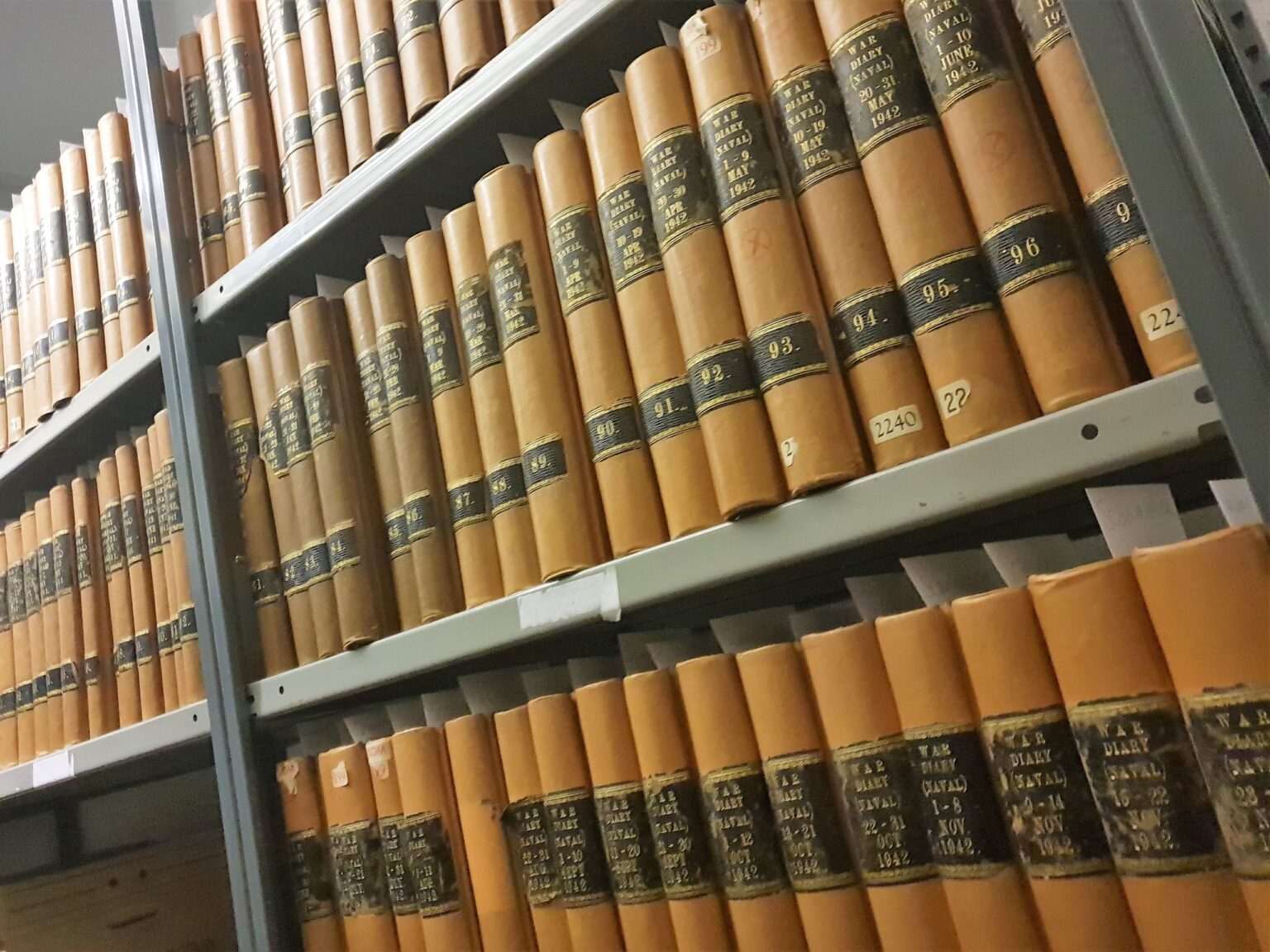
The Royal Navy’s WWII Admiralty Diary records nearly seven years of naval activity across every theatre of the war, in 204 bound volumes. Only two copies survive. Researchers had to visit in person and handle the brittle originals, at the risk of irreversible damage.
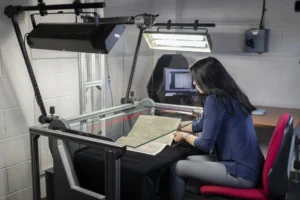
We moved the volumes from Portsmouth in unmarked vans, captured every page on a Zeutschel book cradle designed for fragile collections, and used OCR to turn the diary into a fully searchable digital archive. Researchers can now find a specific event, ship or operation in minutes.
"Releasing valuable and rare documents from the clutches of their protective custodians is often difficult but the staff at Genus understood the misgivings of my colleagues and fears were put to rest."
Christine Harper, Royal Navy Historical Branch
The diary is now a working research tool for the Ministry of Defence and the wider historical community. Read the Royal Navy case study.
OCR makes a collection searchable. Opus adds the next layer: it brings together the records that answer your team’s question, with the original page behind each one.
More questions about Opus
What material can Opus work with?
Opus works with digitised documents, photographs and metadata, and can create an index of them. It can read most file types, including handwriting and microfilm scans.
What if our collection isn’t digitised yet?
Start with digitisation. Opus works from what it can read, so the quality of your scans, OCR and metadata shapes what it can find. Our studio has digitised everything from fragile wartime volumes to Lola Cars’ technical drawings. See our digitisation services.
What happens in an Opus demonstration?
We’ll show you Opus at work on a real archive. Demonstrations can be online or in person, and we agree the format and length with you.
See Opus at work on a real archive
We’ll show you how Opus answers questions across a whole collection, with the original page behind every answer.
Prefer to talk first? Call 024 7625 4955 or email info@genus.uk
The archive doesn't stop evolving. Neither do we.
Opus represents what Genus can offer today, but we are continuing to explore how intelligent archive technology can help organisations get more value from their collections. Your archive holds more than you can search.
Help us discover what’s next.
Our current development work looks beyond simply making material searchable, toward new ways to help organisations understand, connect, and unlock the knowledge held within their archives, while keeping the original material, evidence, and appropriate human oversight at the centre.
For some collection owners, that could also open new opportunities to increase access and create commercial value from archives that have historically been difficult or expensive to exploit.
If your organisation manages a substantial archive and would be interested in contributing to this next stage of development, we would like to hear from you. Selected organisations may have the opportunity to help shape future capabilities and participate in early trials.
Register your interest in the Opus: Genus Archive Intelligence Development Programme
Genus helps organisations preserve the physical collection, secure it, capture it correctly, make it searchable, understand what it contains, discover what was previously hidden, and ultimately increase the archive’s ongoing value.
