Why Engagement Is the New Challenge
Today’s audiences expect more than static displays or flat images online. They want to explore, interact, and even play a role in the story. The European Commission has called this “a digital agenda for culture,” urging institutions to embrace technologies that can unlock new levels of access and engagement.
With Genus’ 3D capture, worldwide audiences can now interact with pieces of history like never before. A single 3D model can serve as a digital lifeline for preservation and restoration, make museums more inclusive, enrich classrooms and research, and help institutions build immersive experiences that stretch far beyond physical walls.
Preservation
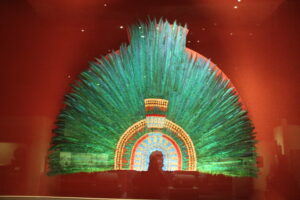
Traditionally, many of the treasures displayed in museums are replicas. A Tyrannosaurus Rex skeleton towering over a school group, or an ornate oil lamp glowing under glass, are often casts or reconstructions rather than the original artefacts. This is not deception, but necessity: originals are too fragile, too valuable for research, or too irreplaceable to expose to the risk of accidents. This is the case for two main reasons: one, they are extremely valuable tools of research which may have serious uses in the scientific world outside of being stared at by captivated school children. And two, these priceless artefacts are simply too fragile to risk being left in the presence of the general public.
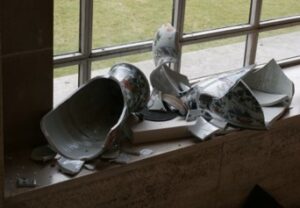
As history has shown us time and time again; accidents happen. Take for example a case from 2006 when some bad luck combined with a loose shoelace sent one Nick Flynn hurtling towards the destruction of two ornamental vases, hailing from the 16th century Qing Dynasty. Sometimes calamities such as this are simply not an acceptable risk. Instead, museums can make use of 3D scanning and printing to create digital/physical models of fragile and rare artefacts which can be used for:
- Preservation – By creating long term digital backups.
- Restoration – Being used as a 3D blueprint to repair artefacts that have already become damaged.
- Global Research – Allowing worldwide researchers access to data to collaborate on without physical handling.
These benefits aren’t theoretical. In Bavaria, Fraunhofer IGD used their CultArm3D-P system to digitise fragile artefacts from Roseninsel (Rose Island). High-resolution scans and 3D printed replicas allowed the objects to be safely displayed to the public, while the originals remained protected in conservation storage, far from the loose shoelaces of the world.
Accessibility and Education
In the educational setting this also means that museums can provide hands-on learning experiences encouraging people to engage with museum pieces in a more meaningful way.
This tactile engagement can be used in many different aspects of education. For example, bridging a gap of accessibility for visually impaired individuals, which until now were unable to appreciate certain pieces of history simply because of their disability.
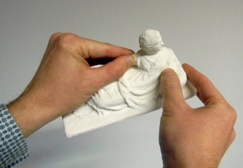
However, organisations such as the National Etruscan Museum of Marzabotto are changing this. By scanning and printing replicas using materials resembling the original (ceramic, marble, bronze) blind or visually impaired visitors are enabled to feel the shapes and textures of historical artefacts that are otherwise too fragile to touch, creating history that you can feel. This also opens doors into the gift shop market, providing visitors with the option to take a piece of history home with them to cherish. This isn’t just technology; it’s a democratisation of heritage.
AR/VR Virtual Engagement
3D scanning doesn’t just preserve artefacts for the future, they unlock a whole new dimension of virtual engagement.
With an estimated 104,000 museums around the world, few of us will ever visit even a fraction of them. Geography, cost, and accessibility barriers mean that millions of people remain disconnected from collections they wish to see. Following the COVID-19 lockdown too, many institutions developed content to continue sharing their collections or even their locations with fans all around the globe. This can be useful for building interest, education or even just to entertain.
Two wonderful examples of this can be seen in the World of Warships: HMS Belfast VR Experience, in which Richard “The Challenger” Cutland and Nicholas “Chieftain” Moran in a mixed-reality VR tell the story of the Battle of the North Cape, to that point the northernmost naval engagement in history, where HMS Belfast played an integral role in the hunt for one of the last big-gun German warships: The Scharnhorst. The video is 3D interactive, which means you can zoom in, turn around, exploring far more of HMS Belfast than you would with a conventional video.
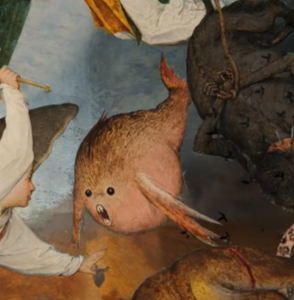
In a more creative application, the Royal Museums of Fine Arts of Belgium have used VR and animation to enhance a showing of Bruegel’s “The fall of the rebel angels” from 1562. By splitting the painting up layer by layer, the curators and art historians could bring more attention to individual elements of the painting that might otherwise have been missed in the chaos such as this ‘blowfish’… not to mention, not needing to fight through tourists to see it!
The Answer to More Meaningful Digital Engagement:
Thankfully, museums are beginning to tackle this challenge head-on with 3D technology. Since 2015, the Smithsonian has begun opening its collections to a worldwide audience by showcasing 3D models of artefacts, specimens, and iconic objects in a highly detailed online catalogue. Online visitors can now rotate, zoom, and explore these pieces as if they were right there in the gallery. Many are even released under public domain, making them free to download for education, research, or even 3D printing.
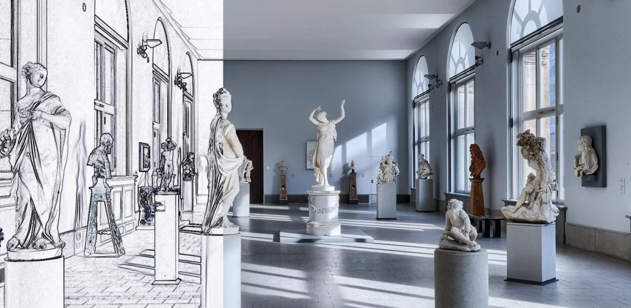
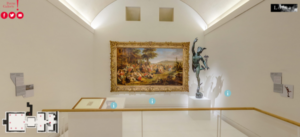
More recently in 2021, the Louvre has been using 3D technology in a broader sense to create extremely Immersive Virtual tours. They do this by using panoramic photography to capture a digital copy of their museum rooms and now they are they are now able to offer online users the freedom of walking through the museum’s halls from the comfort of their home. However, these users can only explore exhibits further in a 2D format, meaning much of the detail is out of reach. (Image taken from The Louvre virtual tour)
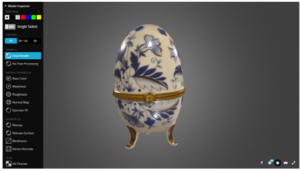
Both the Smithsonian’s online catalogue and the Louvre’s virtual tours mean people from around the world can finally interact with the histories that interests them, but perhaps the most exciting opportunity lies in combining these approaches: embedding high-quality 3D photogrammetry models of individual exhibits within a 360-degree virtual tour.
This way, online visitors don’t just get to wander through their own digital museum, but they can stop, click, zoom in, and truly examine the treasures they most want to in the highest quality of definition. It’s the best of both worlds: the thrill of discovery you get when exploring a museum, and the freedom to interact with objects as though they were in your own hands.
In a year of self-driving cars and artificial intelligence, it is time to make history accessible and bring the GLAM sector up to date. Whether you’re in Tokyo, New York, or just down the road on a rainy day, the possibility of visiting your favourite museum is just a click away.
Genus 3D Capturing
Step 1: Client Consultancy
Every project begins with a conversation. This is where we can establish exactly what your goals are and how we are going to help you achieve them, whether that be long-term preservation, public engagement, educational use, or replica production. Our team ensures the right approach is chosen from the start.
Step 2: Non-Invasive 3D Capture
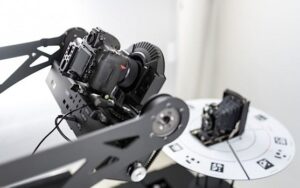
Using our portable photogrammetry rig, we capture hundreds of overlapping, high-resolution photographs of the object from multiple angles. The rig combines a motorised turntable and robotic arm, which move in precise increments to ensure complete coverage of the object. The speed of movement can be adjusted to accommodate fragile heritage pieces and the process itself can even be carried out with no physical contact with the object needed.
Controlled LED diffusion lighting eliminates shadows and glare. We also provide an optional conservation-grade dulling spray to use on reflective surfaces. Whether it’s a delicate glass artefact or a full-size costume, no detail is lost.
Step 3: Processing & Model Refinement
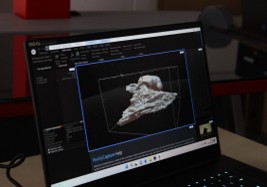
The images are then processed by our team through various specialist photogrammetry software programmes. First, we triangulate shared points across the photographs to generate a detailed 3D Net, which is then textured by our team with the original imagery to produce a lifelike digital twin. At this stage, our technicians refine and enhance the model, cleaning up any noise, correcting shading or colouring issues, and optimising file size, tailoring each object to the specifications of our clients previously discussed goals.
Step 4: Delivery & Application
The finished result is a perfectly rendered 3D model which is formatted to your needs and ready to use. For customers wishing to utilise digital copies for virtual uses this is the end of the process. However, in cases where 3D printing is desired, we will reach out through our pool of experts to offer you many printing options.
